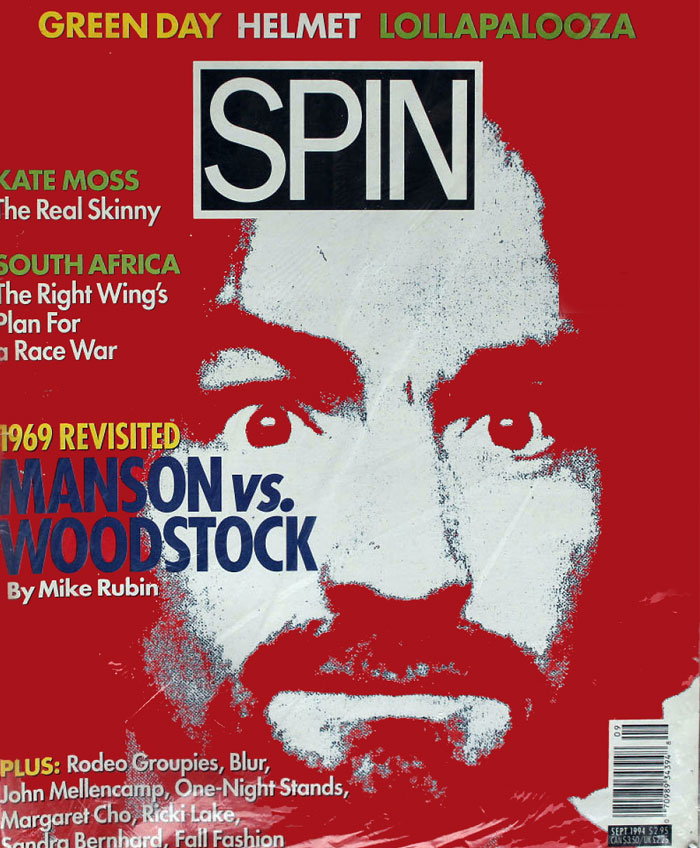
Cover: Charles Manson
Main cover line: “1969 Revisited: MANSON vs. WOODSTOCK” (by Mike Rubin)
Other cover teases (top + left rail): Green Day / Helmet / Lollapalooza, Kate Moss: “The Real Skinny”, and a South Africa political feature (“The Right Wing’s Plan For a Race War”).
Plus (called out on the cover): Rodeo Groupies, Blur, John Mellencamp, “One-Night Stand”, Margaret Cho, Ricki Lake, Sandra Bernhard, Fall Fashion.
What this issue is “about” (the editorial spine)
This is a very “culture-collision” SPIN moment: the magazine uses the Woodstock ’94 media circus (and the broader mid-90s alt-rock boom) as the launchpad to look back at 1969—not as misty-eyed nostalgia, but as a contested mythology. The cover’s provocation (“Manson vs. Woodstock”) is basically asking: what did the dream turn into, and what got buried under the branding?
Feature: “Manson vs. Woodstock” (1969 Revisited)
-
Why it matters: Putting Manson and Woodstock side-by-side is SPIN forcing the reader to hold the era’s “peace & love” iconography next to its darkest cultural underside—same year, radically different symbols.
-
Writer credit: Mike Rubin is explicitly tied to this as SPIN’s September 1994 cover story in his own writing archive.
-
Contextual read: In the early 90s, Woodstock had become a marketable brand again (Woodstock ’94), so SPIN framing the issue as “1969 revisited” feels like a deliberate pushback against easy commodified nostalgia. (That tension is also discussed in broader Woodstock scholarship that references this SPIN cover story.)
Green Day / Helmet / Lollapalooza
These names are positioned like a “state of the scene” banner across the top—SPIN treating the 1994 alt circuit (and especially Lollapalooza) as the new mainstream engine.
Worth noting: Woodstock ’94 and Lollapalooza ’94 overlapped in the cultural conversation, and Green Day’s live notoriety around that era is heavily documented elsewhere (the broader point being: 1994 punk-on-a-big-stage chaos as spectacle).
Kate Moss: “The Real Skinny”
SPIN is doing a very 90s thing here—music magazine as culture magazine—pulling fashion/body politics into the same issue as festival rock and counterculture history. The phrasing on the cover suggests a demystifying/critical angle rather than pure glam profile.
South Africa political feature
The cover line points to a hard political report (not music), and there’s corroboration that John Ryan had a report on the South African elections that appeared in SPIN’s September 1994 issue.
So this issue isn’t just “rock + scandal”—it’s also SPIN leaning into global politics at a pretty serious temperature.
The “PLUS” culture stack (what it signals)
The additional names/topics on the cover suggest the issue’s back half is a grab-bag of sharp culture writing:
-
Rodeo Groupies (very SPIN: subculture anthropology)
-
Blur (Britpop’s US-facing moment beginning to peak)
-
John Mellencamp (heartland rock elder vs the alt era)
-
Margaret Cho / Ricki Lake / Sandra Bernhard (comedy + talk + edge-culture crossover)
-
Fall Fashion (again: SPIN as broader style/culture authority, not only records)