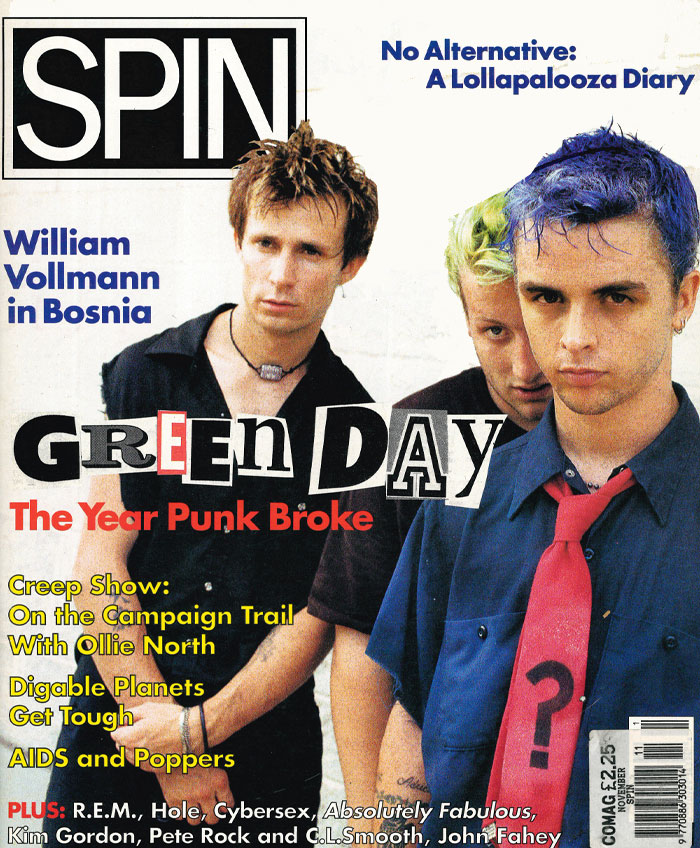
SPIN Magazine 11/1994

$20.00

At A Glance

  • Issue: November 1994

  • Pages: 124 

  • Publisher listing: SPIN Media LLC 

  • Cover star (confirmed via listings): Green Day 

What This Issue Feels Like

November ’94 SPIN sits right in that peak post–Nevermind / post–Dookie moment where alt-rock is fully mainstream, punk is getting pulled into the pop machine, and the magazine is balancing scene-reporting + big-band coverage + culture/politics in the same breath.

Who/What Shows Up Inside (strong signals from the issue’s indexed terms)

Google Books’ indexed “common terms” for this exact issue strongly suggests coverage touching:

  • Green Day (obviously), plus punk/hardcore touchpoints like Bad Religion and NOFX 

  • Smashing Pumpkins and Billy Corgan 

  • Perry Farrell / Lollapalooza orbit 

  • A notable thread tied to Bosnia / Mostar / Serbs / Croats (the index terms lean heavily toward war/geopolitics and places/ethnic groups), implying at least one substantial reported piece with that setting 

  • Left-field / critic-fave presence like Stereolab and guitarist John Fahey 

(I’m calling these “signals” because they’re derived from the issue’s indexed terms list, not a fully scraped table-of-contents page.)

Why Collectors Care

  • Green Day as a 1994 cover story is basically a timestamp for the moment pop-punk flips from “scene” to mass culture. 

  • The mix of alt royalty + punk lifers + international reportage is classic mid-90s SPIN editorial DNA—less legacy-rock, more “what the future is about to become.”

Only 1 left in stock


Description

SPIN in the 90s felt like a magazine with its ear pressed to the floorboards. While a lot of mainstream music press was still clinging to the old rock hierarchy, SPIN leaned hard into what was actually changing the culture in real time. As the decade kicked off, it treated grunge and the wider “alternative” explosion as more than a sound. It was a generational handover. Bands that used to live in the margins suddenly became the center, and SPIN was one of the places documenting that shift with real urgency.

What made SPIN especially important in that era was how wide its idea of “alternative” could be. It didn’t just stop at guitars. The magazine gave hip-hop serious space and treated it as culture, not a novelty, at a time when plenty of legacy outlets still weren’t sure what to do with it. That mix of scenes and voices is a big part of why 90s SPIN reads like a time capsule of where the future was heading.

By the mid-90s, SPIN had enough authority to publish the Spin Alternative Record Guide (1995), a critic-driven map of the alt universe that became a reference point for fans and aspiring writers alike. It’s one of those artifacts that captures the era’s confidence: the sense that a new canon was being built, and SPIN was helping write it.