SPIN Magazine 06/1994

$80.00

Cover: Kurt Cobain (1967–1994)

Issue Info (as commonly listed by sellers/collectors): Vol. 10, No. 3 

What this issue is “about” (the editorial spine)

June ’94 is SPIN responding in real time to the shockwave after Cobain’s death—less a “news recap” and more a meaning-making issue: what Nirvana represented, what the culture projected onto Cobain, and what’s left behind when the symbol disappears. A former SPIN editor later recalled that Cobain wasn’t even planned as the cover subject originally, underscoring how quickly the magazine pivoted into memorial mode. 

A detailed look inside (what we can verify)

1) The core memorial essay:

“Revolutionary Debris” (Kurt Cobain)

A key, widely cited piece tied to this issue is Eric Weisbard’s commentary “Revolutionary Debris”, which scholarship cites as appearing in SPIN, June 1994 (and even notes a page reference). 

How to read it in-context: it’s emblematic of SPIN’s best 90s criticism—treating Cobain not as a rock saint, but as a complicated cultural node where gender, sincerity, punk ethics, fame, and media pressure all collide. 

2) The cover design as an editorial statement

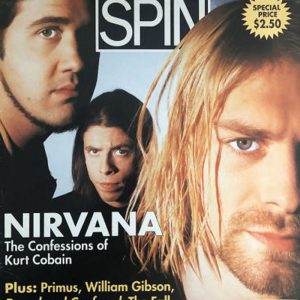
The cover itself is unusually stark: Cobain’s face fills the frame, with the simple memorial line “Kurt Cobain 1967–1994”—no loud cover-story stack, no “PLUS” overload. That minimalism is the message: grief and fixation, not consumer-bait variety-pack.

3) Why collectors chase this one

Beyond Nirvana’s cultural gravity, this issue sits in the immediate post-April 1994 moment, when magazines were racing to define the narrative. That “first wave” memorial framing is a big part of why this issue remains a high-demand back issue. 

1 in stock

Purchase & earn 80 points!
 

Description

SPIN in the 90s felt like a magazine with its ear pressed to the floorboards. While a lot of mainstream music press was still clinging to the old rock hierarchy, SPIN leaned hard into what was actually changing the culture in real time. As the decade kicked off, it treated grunge and the wider “alternative” explosion as more than a sound. It was a generational handover. Bands that used to live in the margins suddenly became the center, and SPIN was one of the places documenting that shift with real urgency.

What made SPIN especially important in that era was how wide its idea of “alternative” could be. It didn’t just stop at guitars. The magazine gave hip-hop serious space and treated it as culture, not a novelty, at a time when plenty of legacy outlets still weren’t sure what to do with it. That mix of scenes and voices is a big part of why 90s SPIN reads like a time capsule of where the future was heading.

By the mid-90s, SPIN had enough authority to publish the Spin Alternative Record Guide (1995), a critic-driven map of the alt universe that became a reference point for fans and aspiring writers alike. It’s one of those artifacts that captures the era’s confidence: the sense that a new canon was being built, and SPIN was helping write it.

You may also like…