SPIN Magazine 11/1993

$20.00

Issue Info: Vol. 9, No. 8158 pages (Google Books). 

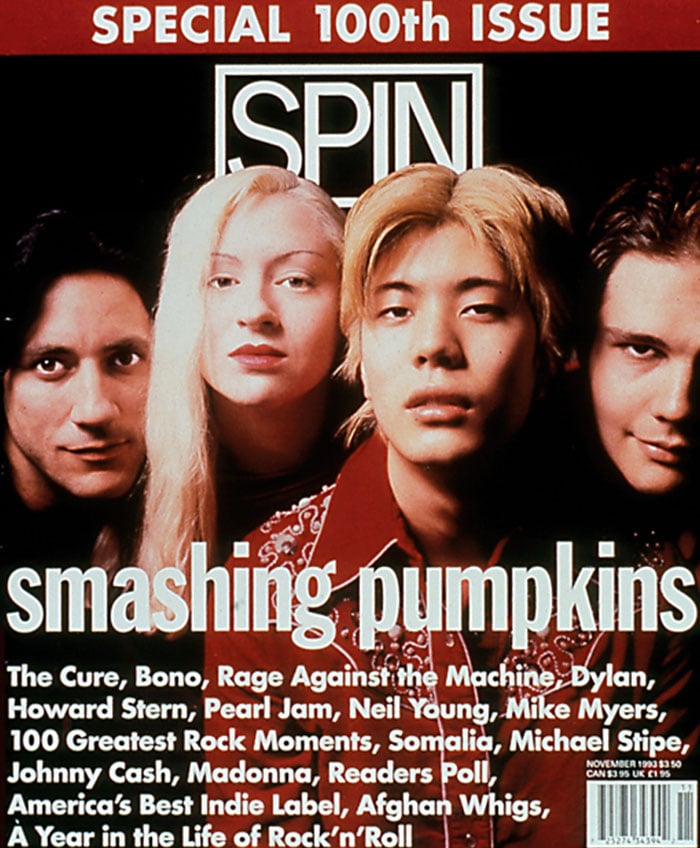
Cover: Smashing Pumpkins — branded as “Special 100th Issue” with a $2.50 special price callout.

Cover lines (what SPIN is promising)

Right on the cover, SPIN frames this as a big, commemorative, everything-at-once package:

  • “Inside: Howard Stern Interview”

  • “100 Greatest Rock Moments”

  • Readers Poll

  • America’s Best Indie Label

  • A Year In The Life Of Rock ’n’ Roll

And the “name wall” of artists/culture figures highlighted includes:

The Cure, Bono, Rage Against The Machine, Dylan, Pearl Jam, Neil Young, Mike Myers, Michael Stipe, Johnny Cash, Madonna, Afghan Whigs (plus Somalia referenced as a topical feature hook).

The editorial spine

Because it’s labeled “Special 100th Issue”, this is less a single-artist “deep profile” month and more a state-of-the-unionSPIN: a big snapshot of what rock culture means at that moment (late ’93), with SPIN’s usual blend of music, celebrity, politics, and scene-making. 

1) Smashing Pumpkins as the cover “face”

Putting Smashing Pumpkins on the 100th issue cover is SPIN signaling: this is a defining band of the present tense—not just a feature act. In late ’93, they’re positioned as a core alt-rock pillar alongside the other scene “anchors” on the cover list (Pearl Jam, Cure, RATM).

2) “100 Greatest Rock Moments” (the time-capsule centerpiece)

This is likely the structural backbone: a canon-building package where SPIN declares what “counts” as rock history—classic icons (Dylan, Young, Cash) living next to contemporary alternative power (Pumpkins, Pearl Jam, Cure, RATM).

3) Howard Stern interview (culture-war lightning rod inside a rock mag)

Calling it out on the cover tells you SPIN is treating Stern as part of the same ecosystem as rock—shock media, censorship battles, provocation-as-entertainment, and “who controls taste.”

4) “A Year in the Life of Rock ’n’ Roll” (SPIN as cultural reporter, not just reviewer)

This reads like an attempt to document the year as lived experience—touring, media scandals, politics, and the way rock bleeds into everything else (hence the cover’s inclusion of Somalia, and a non-musician like Mike Myers in the same breath as musicians).

5) Readers Poll + “America’s Best Indie Label”

These two together are SPIN doing two kinds of authority at once:

  • bottom-up (what the readership crowns),

  • top-down (SPIN anointing an indie institution as “best”).


1 in stock

Purchase & earn 20 points!
 

Description

SPIN in the 90s felt like a magazine with its ear pressed to the floorboards. While a lot of mainstream music press was still clinging to the old rock hierarchy, SPIN leaned hard into what was actually changing the culture in real time. As the decade kicked off, it treated grunge and the wider “alternative” explosion as more than a sound. It was a generational handover. Bands that used to live in the margins suddenly became the center, and SPIN was one of the places documenting that shift with real urgency.

What made SPIN especially important in that era was how wide its idea of “alternative” could be. It didn’t just stop at guitars. The magazine gave hip-hop serious space and treated it as culture, not a novelty, at a time when plenty of legacy outlets still weren’t sure what to do with it. That mix of scenes and voices is a big part of why 90s SPIN reads like a time capsule of where the future was heading.

By the mid-90s, SPIN had enough authority to publish the Spin Alternative Record Guide (1995), a critic-driven map of the alt universe that became a reference point for fans and aspiring writers alike. It’s one of those artifacts that captures the era’s confidence: the sense that a new canon was being built, and SPIN was helping write it.

You may also like…