SPIN Magazine: May 1997 (Vol. 13, No. 2) — Aerosmith “Back In The Saddle” Cover
Cover Snapshot
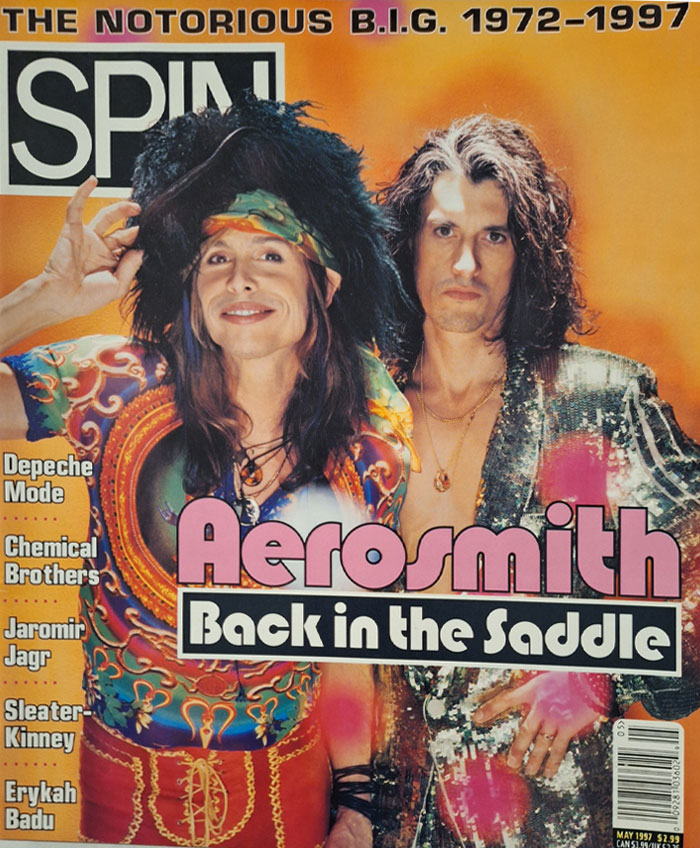
This is the Aerosmith cover with Steven Tyler + Joe Perry and the big headline “Back In The Saddle”, topped with a black memorial strip: “The Notorious B.I.G. 1972–1997.”
The left-column cover teases line up with the issue’s core spread: Depeche Mode, The Chemical Brothers, Jaromír Jágr, Sleater-Kinney, and Erykah Badu.
What This Issue Is Really About (The Vibe)
May ’97 SPIN is doing that very SPIN move where it treats “rock stardom” like a bigger cultural system:
-
Legacy arena-rock survival as a modern business machine (Aerosmith),
-
A major moment of loss in hip-hop (Biggie),
-
The new ‘90s power centers: electronica going stadium-scale (Chemical Brothers), alt icons rebuilding themselves (Depeche Mode), and the insurgent punk/indie wave (Sleater-Kinney).
The Big Features (With Page Anchors)
1) Aerosmith cover story (starts p.60)
The Aerosmith feature is basically an anatomy lesson of how they kept the engine running: management turbulence, sobriety politics, producer swaps, and the internal checks-and-balances that let the band stay functional.
It’s pegged to the Nine Lives era (released March 1997).
2) Sleater-Kinney (p.62)
A scene-and-people driven piece that frames the band’s leap in confidence/joy and the way their music reads as both riot grrrl aftershock and something bigger than politics (community, desire, fun, motion).
3) The Notorious B.I.G. (p.66)
SPIN notes the story was finished shortly before Biggie’s death and published as originally written.
It reads as a contradictions portrait (charisma + melancholy, warmth + hardness), which hits harder because it’s positioned as not an obituary piece at first—then becomes one by force of events.
4) Depeche Mode: “Dave’s Addiction” (p.69)
A straight interview with Dave Gahan in early recovery, talking about sobriety, NA, and learning to live without the old escape hatches.
5) Jaromír Jágr profile (p.84)
A surprisingly literary, personality-first profile of a megastar who hates the exposure part—complete with the “two haircuts” legend and a lot of insight into why he’s so private.
Departments & Front/Back Matter
From the early contents block:
-
Topspin (p.22): Clinton and China human-rights critique.
-
Point Blank (p.24): Letters.
-
Exposure (p.28): quick-hit culture map: pulsars, MTV’s Daria, Erykah Badu, Bloodhound Gang, artist Elizabeth Peyton, and more.
-
Spins (p.109): Reviews (including The Chemical Brothers), movies (Chasing Amy, Irma Vep), and an Icon column on the then-new digital world (junk e-mail, Liquid Audio, e-zines).
-
Genius Lessons (p.136): an open letter to Conan O’Brien.
-
AIDS: Words From The Front (p.99): about AIDS Rides fundraising and the industry around it.
Best Way To Read It (If You Want The “Story” Of The Issue)
-
Aerosmith (p.60) → the big machinery piece.
-
Sleater-Kinney (p.62) → the future punching up.
-
Biggie (p.66) → the emotional center and the time-stamp.
-
Depeche Mode (p.69) → the survival theme, personal scale.
-
Jágr (p.84) → the “fame as burden” epilogue.