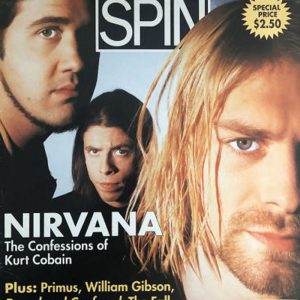
SPIN Magazine 11/1991

$20.00

  • Cover Star: Sinéad O’Connor

  • Cover Photo Credit: Anton Corbijn 

  • Cover lines lean hard into the issue’s theme: human rights, censorship, AIDS and human rights, the death penalty, and a major Sinéad interview. 

What’s Inside (Key Features Highlighted In The Issue)

From the issue’s opening/cover copy and contents framing:

  • Sinéad O’Connor — “uncompromising” wide-ranging interview touching child abuse, the Catholic Church, MTV, and the anthem controversy 

  • “Fear Of Music” — censorship and why governments treat music as dangerous 

  • “Prisoners Of Conscience” — how to adopt/support an Amnesty human-rights case 

  • Death Penalty Feature — examination of capital punishment (“state murder” legal in 36 states, per the issue copy) 

  • Peter Gabriel — “rare interview” framed through the special-issue lens 

  • Wynton Marsalis — interview placing American jazz in historical perspective 

  • AIDS And Human Rights — positioned as a major topic in the issue’s cover/feature list 

Why This Issue Matters

This one’s a time capsule of early-’90s SPIN at its most activist: music journalism explicitly fused with human-rights reporting, using artists (and the culture around them) as the entry point rather than the escape hatch. The “Guest Editor” Amnesty framing is not window dressing—it’s the spine of the whole issue.

1 in stock

Purchase & earn 20 points!
 

Description

SPIN in the 90s felt like a magazine with its ear pressed to the floorboards. While a lot of mainstream music press was still clinging to the old rock hierarchy, SPIN leaned hard into what was actually changing the culture in real time. As the decade kicked off, it treated grunge and the wider “alternative” explosion as more than a sound. It was a generational handover. Bands that used to live in the margins suddenly became the center, and SPIN was one of the places documenting that shift with real urgency.

What made SPIN especially important in that era was how wide its idea of “alternative” could be. It didn’t just stop at guitars. The magazine gave hip-hop serious space and treated it as culture, not a novelty, at a time when plenty of legacy outlets still weren’t sure what to do with it. That mix of scenes and voices is a big part of why 90s SPIN reads like a time capsule of where the future was heading.

By the mid-90s, SPIN had enough authority to publish the Spin Alternative Record Guide (1995), a critic-driven map of the alt universe that became a reference point for fans and aspiring writers alike. It’s one of those artifacts that captures the era’s confidence: the sense that a new canon was being built, and SPIN was helping write it.

You may also like…